2025-2026 NHSEB Regionals Case 3 Public Record, Private Lives

Case 3 in the NHSEB case set winds up being largely about interpersonal ethics, but begins with a privacy policy frame. Coach Michael Andersen in Washington shared the below excellent study guide, which recommends the above excellent privacy-related video by Ethics Bowl researcher and advocate Michael Vazquez at UNC. My team discussed the case week before last, then revisited it briefly last week after watching the video – excellent context which helped sharpen their view. Thanks to both Michaels!

Critique Ethics Bowl to the Rescue at the St. Louis APPE March 2026?

*10/22/2025 Update: two volunteers have stepped forward – thank you, Greg Bock and Tammy Cowart of UT-Tyler’s Center for Ethics!*

As an applied ethicist, the Association for Practical and Professional Ethicsโ€™s annual conference is the most intellectually satisfying gathering Iโ€™ve had the pleasure to attend. My first was in grad school around 2007 (it seems there were several in Cincinnati back then), and itโ€™s always a pleasure to return, especially since the meeting coincides with IEB nationals. Youโ€™re among some of the most serious ethicists from across the country (and sometimes from around the world), as well as many of the most dedicated Ethics Bowl organizers, coaches, judges, and participants.

The 2026 APPE conference will be in St. Louis March 5-8. I plan to be there and use the opportunity to not only catch excellent paper presentations, attend a few IEB nationals rounds, and say hi to old friends, but to share my new book. What better audience for Ethics Bowl to the Rescue than professional ethicists and regional Ethics Bowl champs? And a great way for any author to share their work at an APPE meeting is to host an โ€œAuthor Meets Criticsโ€ session.

If you live nearby, can acquire travel sponsorship, or were planning to attend anyway, I need a couple of thoughtful critics, and Iโ€™ll make your job super easy. Just email matt (at) mattdeaton.com to confirm your interest, Iโ€™ll send you a copy of the book and several ideas. For example:

  1. The bookโ€™s title suggests something Ethics Bowl cannot deliverโ€”a fast and certain โ€œrescueโ€ from our perilous situation.
  2. Deaton repeatedly invokes Socrates throughout the bookโ€”on the cover, in the opening chapter, in the Bowls Behind Bars chapter, in the closing chapterโ€”yet presents arguments that are not as rigorous as Socrates himself would have endorsed.
  3. Ethics Bowlโ€™s peaceful, conciliatory approach to difficult moral and political issues is apt to be taken advantage of by unscrupulous political extremists and therefore ought not be encouraged โ€“ Ethics Bowlers ought to be joining debaters rather than the other way around.
  4. Recruiting ethicists, philosophers, and ethics-minded debaters to join the Ethics Bowl movement risks diverting energy more desperately needed on the front lines of the fight for democracy and justice.
  5. Deatonโ€™s aggressive denunciation of traditional debate is too heavy-handed and apt to alienate more debaters that it recruits.
  6. In vigorously advocating for Ethics Bowl and at times attacking and demeaning traditional debate, Deaton adopts what he claims to be arguing to supplant โ€“ an attack-style debate-like approach.
  7. While Deaton claims to be a serious ethicist and friend of high moral standards, he mentions several behaviors unbecoming of a moral exemplar, including:
    • Training martial arts, which are violent
    • Driving an F-150 across the country, contributing to greenhouse gas emissions
    • Recommending that Ethics Bowl teams and educators learn to use AI as a coach and thought partner, completely neglecting AIโ€™s extreme power consumption and potential impact on the environment

I have responses to the above, but not all will be fully satisfactory, and Iโ€™m OK with that. The book wasnโ€™t intended to be a bulletproof philosophical argument, but an Ethics Bowl recruiting tool, which means in many cases readability, personability, and entertainment overrode logical rigor.

Really, itโ€™s ripe for critique. So if youโ€™re up for joining my Author Meets Critics session at the 2026 APPE conference next March in St. Louis, letโ€™s do it!

2025-2026 IEB Regionals Case 12 Lady Justice

Intercollegiate Ethics Bowl case 12 is on โ€œthe intentional murder of women because of their genderโ€ or femicide. My team broached this sad topic last week, and one promising approach to decreasing femicide discussed in the case is mitigating possible root causes. For example, โ€œthe South African governmentโ€™s approach to femicide has emphasized financial independence, built on the assumption that resolving economic hardship can help assuage the conditions that lead to femicides,โ€ presumably under the assumption that women completely dependent upon men might be more vulnerable to inescapable violent relationships.

For a small-scale, grassroots example of a strategy to decreasing domestic violence generally, an organization where I live in East Tennessee hosts an annual “Me and My Guy” daddy daughter dance as a way to encourage men to treat women with dignity and respect, and for young women to internalize the belief that they deserve respectful treatment. That way theyโ€™ll be more likely to demand it from otherwise abusive partners, or leave/avoid abusive relationships altogether. This modest annual event is something my daughter and I have done for several years, always look forward to and enjoy. I recommend it to all the local dads I know with daughters, and last year we were joined by my nephew and great-niece. And I think beyond bringing particular young ladies and their father figures closer together, the event has to be raising standards among participating girls’ friend groups, and well as attitudes among dads’ coworkers, friends, and families.

Another strategy countries are using to decrease femicide is enhanced legal punishments. My IEB team may change their mind, but their initial take was that such laws would be unlikely to enhance deterrence unless thereโ€™s a substantial gap between punishments for killing women versus killing anyone. At least in the U.S., a murder conviction can already bring life imprisonment or even execution in some states, so some sort of additional pain would need to be included for femicide-specific murder convictions to proactively shape the behavior of would-be perpetrators. However, maybe anti-femicide laws could reinforce the wrongness of targeting womenโ€”just as hate crimes laws reinforce the wrongness of targeting victims due to the religion, ethnicity, etc.โ€”and over time shape cultural values such that fewer hate crimes or femicides would occur? In this way, perhaps anti-femicide laws are both a direct deterrent and a cultural-shift strategy? Perhaps. And maybe this is the real goal of such laws since many (if not most) would-be murderers arenโ€™t making rational risk calculations, but acting out of rage or irrationally generally. A few other ideas our team broached on the enhanced punishments angle:

  • Itโ€™s unclear when femicide-specific punishment enhancements would/should triggerโ€”anytime a woman is murdered, or anytime a woman is murdered solely/mainly/in part because sheโ€™s a woman?
  • Itโ€™s unclear how these laws would deal with cases where the perpetrator is herself a woman (same punishment?)
  • Itโ€™s unclear how these laws would deal with cases where the victim or perpetrator is nonbinary, which the case acknowledges in the closing sentence

What do you think? Do other questions, possible solutions or analogies IEB teams should be considering come to mind? If so, please leave a comment. Not a happy topic, but definitely worth discussing, and perhaps a problem the Ethics Bowl community can help address. In the meantime, kudos to the Monroe County Health Councilโ€”looking forward to the next dance in December.

Ethics Bowl Improves Test Scores?

An excerpt from Vazquez and Prinzing’s 2025 study, highlighting and SuperSocrateses added.

Chapter 9 of Ethics Bowl to the Rescue! is all about the connection between studying philosophy and scoring higher on standardized tests. Whether we personally care about state-mandated primary or secondary school tests, college or grad school entrance exam scores, is irrelevant, because administrators who decide whether to support existing Ethics Bowl programs or found new ones often do. For years, advocates have been able to cite a study by Scottish researchers Trickey and Topping that found that 10-to-12-year-olds who participated in one hour of weekly philosophical discussion improved their verbal, non-verbal, and quantitative scores on the Cognitive Abilities Test by an average of 7 points compared to a control group. This was cool and encouraging, but small and obscure. It was the pretty much the best we had to offer, so we’d offer it anyway. That is, it was the best we had to offer until this summer when researchers Michael Vazquez and Michael Prinzing released a much broader and more impressive meta-analysis of college-aged students. Here’s an excerpt from the book – enjoy, and thank you, Michaels!

If youโ€™re encouraged by Topping and Trickeyโ€™s work, but discouraged that this is the best we can do, would a multi-year analysis covering over half a million undergrads from 800 U.S. colleges and universities help? Thanks to the extended labors of Michael Prinzing of Wake Forest and Michael Vazquez of UNC, your wish is my command.

Published by the Journal of the American Philosophical Association in 2025, barely in time to be included in this book, the Michaels sought to scrutinize the claim that studying philosophy boosts test scores. Using mathematical wizardry and a fancy stats program called โ€œR,โ€ they isolated test performance improvement by comparing college majorsโ€™ average law school (LSAT) and grad school (GRE) entrance exam scores relative to studentsโ€™ pre-college SAT scores. That way, theyโ€™d reveal not whether students who gravitate to philosophy happen to be good at taking tests (they apparently are), but whether studying philosophy improves test-taking ability. In other words, they sought out to answer whether phil majors became comparatively better at standardized test-taking over the course of college, compared to students of comparable pre-college ability who studied other subjects. For good measure, they threw in student self-reports on scholarly virtues to see which college majors attracted and cultivated the most serious students. How did philosophy fare?

Our results indicated that students with better verbal reasoning abilities and more curiosity, intellectual rigor, and open-mindedness are more likely to major in philosophy. They also indicated that, after adjusting for baseline differences, philosophy majors outperform other students on these measures. In fact, on average, philosophy majors score higher than all other majors on the GRE Verbal and LSAT, as well as a self-report measure designed to assess good habits of mind.[1]

If you take a look at the study, which is openly available online (just google the title: โ€œStudying Philosophy Does Make People Better Thinkersโ€), flip to page 11 to see philosophy majors at the tippy top of the adjusted average LSAT scores tableโ€”ahead of political science, history, chemistry, and all flavors of engineering. On the GRE Verbal table, philosophy beats every major again, including languages and literature, and even English. On the GRE Quantitative, philosophy is middle of the pack, but certainly not at the bottom, and primarily behind math-heavy majors including mathematics/statistics, physics, computer science, and accounting, though somehow business administration and management beat us (dang itโ€ฆ).

The study is brand new, and maybe some future criticism will reveal flaws. Plus, Iโ€™m predisposed to want it to be true, and you might be as well. But it sure seems credible, even if the methodology is way over my head (mixed-effects regressions for dichotomous outcomes with random interceptsโ€”what?).[2]

Independent of whether weโ€™re fluent in Statistician, thanks to Vazquez and Prinzing, when we pitch Ethics Bowl and philosophy to administrators, we now have a recent, broad, ultra-impressive study to cite. And the news gets even better. I reached out to the Michaels for their help with this section, and they shared that Ethics Bowl-specific test score improvement studies are on their research agenda. Shoot yeah. Thank you, Michaels!


[1] โ€œStudying Philosophy Does Make People Better Thinkers,โ€ Journal of the American Philosophical Association, published by Cambridge University Press, 2025, page 13.

[2] โ€œOur analyses used mixed-effects regression models (logistic regressions for dichotomous outcomes) with random intercepts for institutions (i.e., the colleges and universities that students attended). We fit these models using the lme4 and lmerTest packages in R (Bates et al. 2020; Kuznetsova, Brockhoff, and Christensen R. H. B. 2017), computed estimated marginal means using the emmeans package (Lenth et al. 2018), and used multiple imputation to accommodate missing data with the mice package (Buuren and Groothuis-Oudshoorn 2011). The code used in these analyses is available online (https://osf.io/4S693),โ€ ibid, page 7.

2025-2026 NHSEB Regional Case 9 Pulled to Protect

NHSEB Case 9 “Pulled to Protect” pits parents’ rights to raise their children how they think best against society’s responsibility to ensure all kids enjoy an adequately supportive childhood. As the case analogizes, we’d intervene if parents allowed a child to play with fire (imagine your neighbor’s 9-year-old mixing gasoline with fireworks – you’d call somebody!). But the question here is whether we should similarly intervene when parents fail to ensure their kids are adequately educated, which sometimes can be motivated by understandable reasons, such as the desire to preserve their way of life (example: the Amish).

I’ve actually been using an ethics journal article to cover a similar, overlapping issue in my college ethics classes since 2020. “Sport, Parental Autonomy, and Children’s Right to an Open Future” by Nicholas Dixon is ultimately about parents appropriately supporting their kids’ athletic interests (not living vicariously through them, exposing them to various options to see what resonates, and only pushing extended time and effort when they love a sport and are truly great at it). But he touches on the exact issue and Supreme Court case as this Ethics Bowl case, “Pulled to Protect.”

What’s more, coach Michael Andersen’s team just covered this case, he shared his awesome-as-always study guide (which includes multiple bonus resources), and it and my 9-minute lecture on the Dixon article are below. Enjoy!

Kicking off the 2025-2026 Ethics Bowl Season with a Revised Case Analysis Guide

Coach Michael Andersen recently updated the case analysis guide he shared here in 2023 with several improvements. Inspired by Dr. Sean Riley’s video, tips that stood out to me included step 2: “What kind of case is this?”, the invitation to radically emphasize with stakeholders, and the concentric circles visual. It also links to an updated case summary template.

Coach Michael considers these works in progress. But as far as I’m concerned, they’re more than good enough to begin using immediately, which is a good thing since both the IEB and NHSEB case sets recently went live. If you haven’t reviewed them already, the 2025-2026 IEB regionals case set is here and the NHSEB set here. Some super cool topics this season. More on the cases soon.

Enjoy, thanks coach Michael, and happy Ethics Bowl season kickoff!

Ethics Bowl to the Rescue Officially LIVE

After five years, Ethics Bowl to the Rescue! Saving Democracy by Transforming Debate, is finally live (went live yesterday, September 15th, which happens to be International Democracy Day). Whew! That feels nice to say. Finally. The paperback is on Amazon, and it’ll release in hardcover and on Kindle by mid-October.

A huge thank you to the DOZENS of volunteers who submitted interview question answers, and my five devoted and generous beta readers: Michael Andersen, Lisa Deaton, Pat Hart, Richard Lesicko, J. Overton, and Court Lewis. It’s so much better thanks to your careful reads and improvement suggestions.

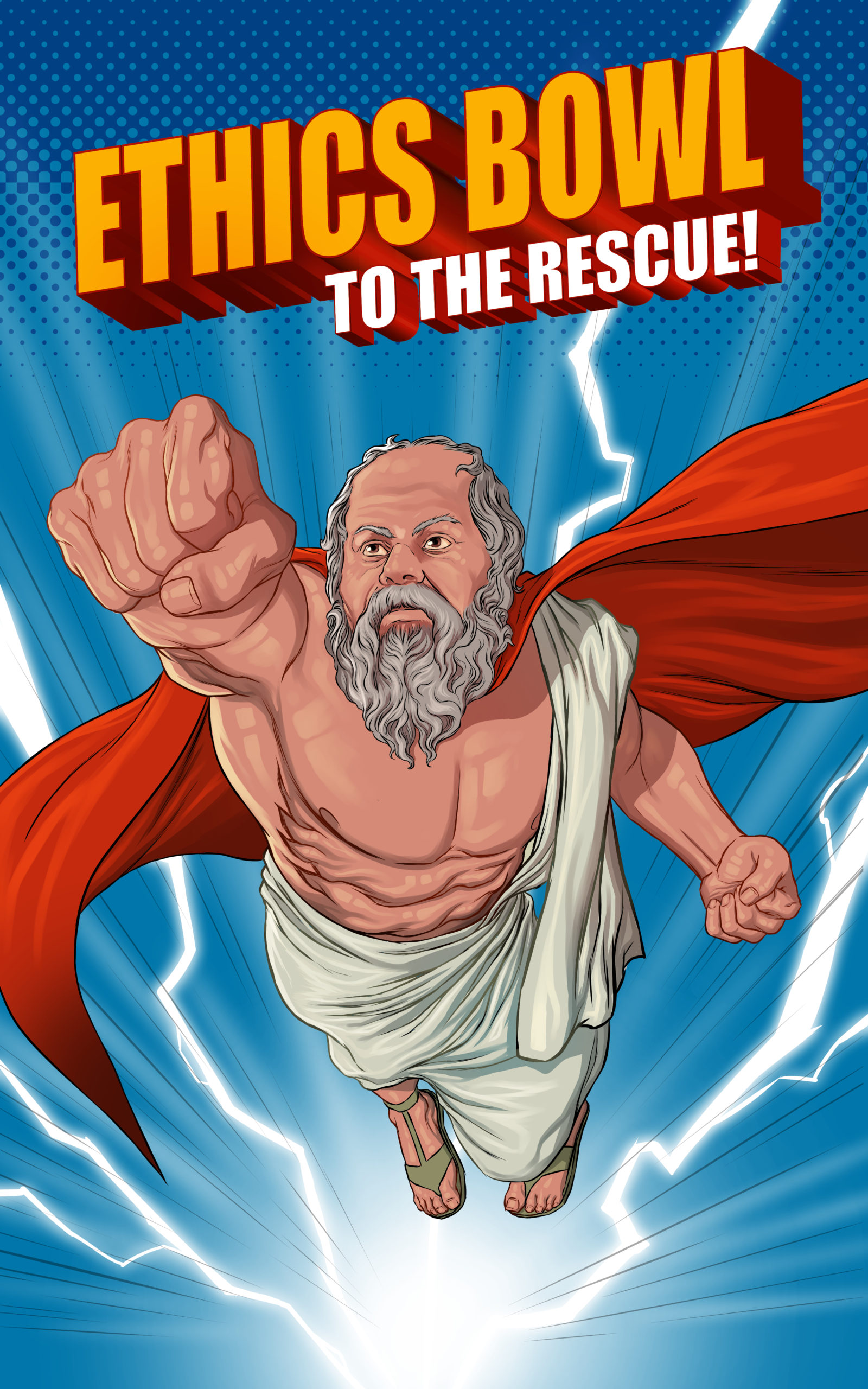
Also thanks to artist Niezam for the awesome SuperSocrates character illustration and cover. He’s currently working on the graphic novel for the latest movie versions of Dune – so glad to see your talents being appreciated, new and bigger doors opening. Not that this book cover wasn’t as huge of a deal as Dune ๐Ÿ™‚

Ok, time to order a batch of author copies and confirm addresses. If you’re in the book and I have your address already, one will be coming your way around the end of the month. If you submitted interview question answers (which means I almost certainly found a way to include you in the book) and I haven’t asked for your address, feel free to go ahead and send it to me. And even if you’re not in the book, if you’re up for writing an honest review, just email me at matt (at) mattdeaton.com and I’ll hook you up as well.

Cheers! It feels great to finally be able to share the awesomeness of Ethics Bowl with the world. Ethics Bowl isn’t a quick fix. But it will most certainly help, and at a time the world seemingly needs thoughtfulness, civility, and mutual respect more than ever.

Ethics Bowl to the Rescue! Releasing on International Democracy Day – Monday, September 15th

After 5 years of researching, interviewing, writing, and editing, Ethics Bowl to the Rescue! Saving Democracy by Transforming Debate will release this coming Monday, September 15th, which happens to be International Democracy Day.

Dozens of generous volunteers from four continents contributed to the project. From submitting interview question answers, to writing testimonials, to beta reading – I’m so glad we can finally share it with the world. Special thanks to IEB, Ethics Olympiad, A2Ethics, and Mount Tamalpais at San Quentin for permission to include various pictures. Selection and placement added a few weeks to the timeline, but was well worth it.

The book will be available at Amazon in paperback first, then in hardback and ebook . But for anyone willing to write an honest review, please email the best mailing address to matt [at] mattdeaton.com and I shall gladly hook you up. Reviews are especially important for new books, so thanks so much for considering. Here’s a preview:

Putting the Final Touches on Ethics Bowl to the Rescue!

Coming into the home stretch on Ethics Bowl to the Rescue! Saving Democracy by Transforming Debate, last-minute improvements include:

  1. Adding a chapter on Ethics Bowls in prisons (did you know Ethics Bowls are practiced in correctional facilities in at least 5 U.S. states? I didn’t!) – CHECK
  2. Adding a section on Ethics Bowls in retirement communities (one in Florida, where Jerry Seinfeld’s quirky parents retired, and another in New York, though six hours+ from Jerry, Kramer, Elaine, and George in Manhattan) – CHECK
  3. Adding around two dozen PICTURES (super thanks to Ethics Olympiad in Australia, APPE/IEB, Mount Tamalpais College at San Quentin, A2Ethics in Ann Arbor and others for permission to use them!) – CHECK
  4. Beefing up the chapter on Ethics Bowl improving test scores (Michael Vasquez and Michael Prinzing just released this study on philosophy improving test scores – gotta get it in there, and possibly something from the NHSEB imact studies) – PENDING – just sent an email to Michael V. this morning

So, almost done. To everyone who’s contributed, inquired, and patiently waited, thank you. Five years in the making. Just a few more days…

Excellent Ethics Bowl Overview Video

I’m coaching a new high school team this season (while putting the final touches on Ethics Bowl to the Rescue! Saving Democracy by Transforming Debate – due out VERY soon), and in looking for an example of an Ethics Bowl to share with them, came across this excellent overview video by Dr. Sean Riley, Long Island HSEB championship-winning coach, Baylor philosophy Ph.D., and Chief Strategy Officer of Stony Brook School. He covers differences between Ethics Bowl and traditional debate, how to frame and work through cases (decide if it’s more policy or interpersonal, identify stakeholders, adopt an empathetic mindset), and even works through an example: ‘Til Death Do My Part, from the 2023-2024 regional case set. It’s really good – good enough for me to immediately share with my team. So, coaches, as you’re recruiting and welcoming new team members, consider doing the same. It would of course work equally well for Intercollegiate Ethics Bowl and Ethics Olympiad teams.